Wednesday, December 14, 2011

The Changing Nature of Global Gas Projects

The Changing Nature of Global Gas Projects

I wrapped up my recent trip to Russia at 4 a.m. last Friday in a Moscow airport. 

One thing is certain about my trips to Russia - the time schedule is always off.

But I can't complain; the weeklong visit provided many benefits. 

As I told you two weeks ago the primary purpose of my trip was to evaluate natural gas projects in northern Russia. It's becoming increasingly necessary to estimate global-wide gas prospects in order to determine effective price levels.

That's because the age of "spot" market prices in the gas sector is rapidly approaching. 

And it's about to change the way the markets operate for everyone involved.

On the Spot

Spot markets allow for a very short-term exchange of volume (usually 72 hours) and serve to undergird longer-term contract pricing.

The spot markets tend to offset longer contract terms by providing volume at what is usually a discount to the contracts, which are more properly futures contracts on natural gas.

However, natural gas has not had featured spot sales except in those areas that serve as major centers for pipelineinterchange. Those areas then become provisional benchmarks for wider markets.

This is different than crude oil, which can be moved by tankers to virtually anywhere there is a decent port, allowing the establishment of local spot markets. Gas, on the other hand, has been limited by how far pipelines extend. 

But the acceleration of liquefied natural gas (LNG) trade - in which gas is cooled to a liquid state, transported by tanker, and then "regasified" on the other end - has altered the picture. 

Completely.

Indeed, with more than 90 new terminals set to open, under construction, or in the final stages of approval worldwide, LNG is one of the most decisive changes to hit the energy sector in decades.

LNG imports are essential to meet energy needs in parts of the world where there's little domestic supply. Exporting LNG also provides a new outlet in those regions where new unconventional gas volume strains local demand and threatens adequate price levels for producers.

This latter consideration affects all major shale gas production basins in North America, from the Horn River and Montney in Western Canada to the Marcellus, Barnett, and Fayetteville in the United States. 

And, as I have noted on several occasions, the rise of LNG trade can serve as a major excess production drain off for the United States. 

What LNG does not do, however, is address a growing global concern. 

See, it is one thing to provide an end market for additional production. It is quite another to integrate the production assets into the equation.

Let me explain. 

New Report:
America's Energy Mega-Shift:
How To Profit As "Home Grown" Fuel Takes Over The 
U.S. Power Market
Sign up now to receive this free report from Dr. Kent Moors.
Enter Email Address Here:
 
Cancel at any time | How it works

Reassessing Asset Values

LNG trade - involving gas production in one country and usage in another - benefits the volume of gas involved, but does nothing to provide for pricing the land assets where production takes place. 

Unlike crude oil, which is now mostly produced in countries that serve as exporters and have little overall domestic demand for the product (Russia being a major exception), gas remains primarily a domestically utilized energy. That means the primary market served remains a local one.

However, should international demand become the primary determinant of gas prices, the value of productive acreage would likely become dependent on the LNG trading price. 

Yet relying on LNG to determine the price of both commodity and field would be the energy-sector equivalent of the tail wagging the dog.

Given that the rapid rise of global gas trade is now a certainty, there needs to be a way to balance local, national, and international gas prices with the underlying value of the land where production takes place.

Which brings me back to the other reason I traveled to Russia. 

The Financing Gap

As the costs of major gas projects increase, especially in locations like the Arctic, new funding prospects are required. 

As I've told you, Moscow will not allow foreign majors to control these new mega projects, so there are few established ways of obtaining the huge amount of necessary funding.

My suggestion is to use assets in one basin to collateralize financing projects in another country. 

That would allow the value of acreage that is, or could be, used for gas production in, say the United States, to be tied to the value of production in Russia (for conventional gas) or Poland (for shale gas).

Extractions elsewhere serve to buttress the overall value of U.S. assets, while the American assets serve as a financial base for projects abroad and participate in the revenue flow of foreign production.

The suggestion likewise provides for cross-finance of U.S. projects from proceeds generated elsewhere, as well as the development of genuine holdings not requiring that one market wins while another loses.

In short, this overcomes competition by providing a win-win scenario to replace the zero-sum game usually played (somebody's production undercuts the market access of somebody else).

We end up creating a genuine global view of production without discounting the value of anyone's fields, anywhere.

And What of the Individual Retail Investor?

Well, we certainly have been talking a lot about Master Limited Partnerships (MLPs) in the U.S. gas industry. Remember, these are the holdings that control production, or more often, midstream services (pipeline, storage, gathering, and initial processing). 

By law, MLPs pass all profits to partners, allowing the holding to avoid corporate taxes. All tax liability on profits rests with the individual partners. 

When an MLP chooses to do a public offering, the shares that make up that offering participate in the flow-through profits via dividends that are considerably better than market averages. That way average investors are able to participate without becoming partners in the MLP itself.

I have suggested the same approach for what I have in mind. Placing a portion of these European/Russian/U.S. cross-holdings, representing gas deposits in various countries, as accessible public offering provides three main benefits: 

  • It raises additional funding for gas projects using existing acreage and/or production as collateral.
  • It provides predictability for the local impact of variations in field value.
  • And it expands participation to average investors worldwide.
The first of these initial public offerings (IPOs) will probably emerge in Frankfurt (which is why I was there two weeks ago). The prompt issuances of depositary receipts will make them accessible in major markets throughout the world. 

Sometimes the way to offset commodity warfare and the "either-you-win-or-I-do" view is to give each participant a vested stake in the idea of working together.

I'll let you know how it works out.

News and Related Story Links: 


Tags: 
Fuente:

Saludos
Rodrigo González Fernández
Diplomado en "Responsabilidad Social Empresarial" de la ONU
Diplomado en "Gestión del Conocimiento" de la ONU
Diplomado en Gerencia en Administracion Publica ONU
Diplomado en Coaching Ejecutivo ONU( 
  • PUEDES LEERNOS EN FACEBOOK


 CEL: 93934521
Santiago- Chile
Soliciten nuestros cursos de capacitación  y consultoría en GERENCIA ADMINISTRACION PUBLICA -LIDERAZGO -  GESTION DEL CONOCIMIENTO - RESPONSABILIDAD SOCIAL EMPRESARIAL – LOBBY – COACHING EMPRESARIAL-ENERGIAS RENOVABLES   ,  asesorías a nivel nacional e  internacional y están disponibles  para OTEC Y OTIC en Chile

Monday, December 12, 2011

The BRICs Will Be Dead Weight in 2012 – Invest in These Five Emerging Markets Instead

The BRICs Will Be Dead Weight in 2012 – Invest in These Five Emerging Markets Instead

[Editor's Note: This special report on emerging markets is part of Money Morning's annual "Outlook" series, which forecasts the prospects for stocks, commodities, and other top profit opportunities in the New Year. Our last forecast covered gold.]

Don't let the headlines fool you, there's lots of money to be made in global investing in 2012.

You're just going to have to be careful - more so than in years past - because right now the line drawn between successful markets and markets that are in danger of collapse is treacherously thin.

Take the fashionable growth markets, the BRICs - Brazil, Russia, India and China - for example.

Dead Weight

It's been 10 years since Chairman of Goldman Sachs Group Inc. (NYSE: GS) Asset Management Jim O'Neill coined the BRIC acronym. His recommendation was certainly effective - one of the best of all time, even. But today, all four BRIC countries face problems, and their troubles illustrate the dangers of following investment fashions.

Just take a look:
  • China appears the least troubled of the four BRICs. However, it looks to be facing a recession, inflation is approaching double digits and there is a massive bad debt problem in the banking system. Too much money has been invested in uneconomic rubbish - "malinvestment" as the Austrian school of economics calls it. My own guess is that China will do fine long-term but you probably don't want to invest until the size and shape of its problems is clear.
  • India has a government that can't stop spending, inflation over 10% and huge corruption. Furthermore, its stock market is still pretty inflated. I wouldn't put much money there until the government changes. Contrary to what you read in the media, almost all the real liberalization progress came under the Vajpayee government of 1998-2004, which the Indian electorate then ungratefully threw out. I'd want an Indian government without the corrupt socialist Congress Party before I'd invest; only then could I be sure that Indian gains would not be poured down a rat hole.
  • Brazil has been run by big-spending socialists since 2002 and has been immensely lucky to benefit from the commodities boom. Now the boom has topped out (probably temporarily) but its government is still overspending and has begun to harass foreign investors. Brazil is in big trouble if commodities prices fall.
  • In Russia, Vladimir Putin will become President again next March. Need I say more? Like Brazil, Russia has benefited immensely from the commodities boom (in its case, primarily the run-up in oil prices). However, it treats foreign investors even worse than Brazil does, it is even more corrupt and it appears to be running out of money.
MM Outlook 2012 If the BRIC's prospects are bad, those of much of Europe are even worse.

The Eurozone's debt problem could have been solved early on by throwing Greece out of the euro (a much deserved punishment). However European authorities have now thrown so much money about in such unproductive ways that it's doubtful whether the euro is even salvageable anymore.

A recession in 2012 seems unavoidable, although Germany may benefit from the problems of its trading partners (if it is not forced to bail them out). Well-run European Union (EU) members that are not part of the Eurozone, such as Poland, may also benefit from the chaos, although Poland's current foreign minister Radek Sikorski doesn't seem to think so.

Japan has done so badly for so long that it may be impossible to revive. If public debt were still at the level of a decade ago, Japanese shares would be a screaming buy, as the market is at a quarter of its 1990 peak. However, with debt around 220% of gross domestic product (GDP) and no sign of the country's budget problems being solved, it may be nearing the point of no return and eventual debt default. On the whole, it's best avoided.

Apart from the United States, that leaves one obvious rich-country market,
New Report:
America's Energy Mega-Shift:
How To Profit As "Home Grown" Fuel Takes Over The
U.S. Power Market
Sign up now to receive this free report from Dr. Kent Moors.
Enter Email Address Here:
Cancel at any time | How it works
Canada, and some emerging markets of East Asia and Latin America likely to come out on top. (Australia is currently badly run, and looks likely to "kill the goose that laid the golden eggs" by taxes and environmental regulations.)

Emerging Opportunities

Canada and Chile are well run and benefit from current high commodity prices. Malaysia does, as well, while South Korea and Taiwan would benefit from a fall in prices. And Singapore does well in all environments except a major world slump, which I don't expect.

The best way to invest in most of these markets is through exchange-traded funds (ETF).

For Canada that's the iShares MSCI Canada Index ETF (NYSE: EWC), with net assets of $5 billion and a price/earnings (P/E) ratio of 14. For Chile, there's no ETF, but the Aberdeen Chile Fund (NYSE: CH) is well run, although small with a market capitalization of $130 million. For Malaysia, the iShares MSCI Malaysia Index ETF (NYSE: EWM) has net assets of $929 million and a P/E of 15. As a hedge against a commodity price crash, look at the iShares MSCI Korea Index ETF (NYSE: EWY) and the iShares MSCI Taiwan Index ETF (NYSE: EWT).

If that's not enough, however, there is one more emerging market that's positioned to do very well in 2012. It is well governed, has ample natural resources, and is currently planning a huge infrastructure build-out. That makes it a prime investment opportunity. However, that recommendation is only available to Money Morning Private Briefing subscribers.

If you're already signed up then you can read all about it in today's issue. If not, then I highly recommend you sign up by clicking here. That way, in addition to today's pick, you'll receive dozens of other top-tier recommendations.

News and Related Story Links:

Tags: ,

Fuente:

Saludos
Rodrigo González Fernández
Diplomado en "Responsabilidad Social Empresarial" de la ONU
Diplomado en "Gestión del Conocimiento" de la ONU
Diplomado en Gerencia en Administracion Publica ONU
Diplomado en Coaching Ejecutivo ONU( 
  • PUEDES LEERNOS EN FACEBOOK


 CEL: 93934521
Santiago- Chile
Soliciten nuestros cursos de capacitación  y consultoría en GERENCIA ADMINISTRACION PUBLICA -LIDERAZGO -  GESTION DEL CONOCIMIENTO - RESPONSABILIDAD SOCIAL EMPRESARIAL – LOBBY – COACHING EMPRESARIAL-ENERGIAS RENOVABLES   ,  asesorías a nivel nacional e  internacional y están disponibles  para OTEC Y OTIC en Chile

Wednesday, December 07, 2011

Previous Mises Daily IndexThe Risk of Sovereign Debt

The Risk of Sovereign Debt

Mises Daily: Wednesday, December 07, 2011 by

A
A

With a 50 percent haircut recently given on the Greek sovereign-debt question, investors are increasingly asking what the real risk of sovereign debt is. It would appear that investors underpriced the risk inherent in sovereign debt, especially that of Europe's periphery. One might even go so far as to say that investors made foolish choices in the past and are now getting their just deserts.

Such statements require an assessment of what the specific risk is of holding sovereign debt, and how specific European institutions affected these risk factors.

Debt is in almost all cases collateralized by some asset. A mortgage is backed by the value of the house that it is borrowed against. Student loans are backed against the future earnings ability of the student (or their parents' income and assets if cosigned). In almost all cases debt is collateralized by the asset that it is used to purchase.

Sovereign debt is slightly different, as no clear asset stands ready to serve as collateral. Instead, borrowing is backed by the future taxing capacity of the state. When investors purchase sovereign debt, they do so knowing that if their plans turn out wrong they will not be receiving some portion of that state's assets as the consolation prize. They purchase the bond knowing that the ability to repay is conditioned by the future economic health of the country, and also by its future taxing power. As there is a general negative relationship between tax rates and economic health there is an upper bound on how much tax revenue can be raised in the future to pay off debts incurred today.

When we say that sovereign debt is "risk free," we mean that there is no credit risk. A state is forever able to pay off its nominal liabilities in one of two ways: either it increases its taxes to raise more revenue (through direct taxes), or it monetizes its debt by increasing the money supply (an inflation tax).

Central banks are, by and large, granted some degree of operational independence in order to avoid the second circumstance. The inflation tax is an extremely attractive way for a state to pay for its liabilities. No one pays it directly, and hence there is a reduced chance for "taxpayers" to see the wealth appropriation. A government given direct control of the printing press has an incentive to give higher rates of inflation than the public desires, if only to pay off the debts it incurs. Central-bank independence removes this option.

Sovereign debt is not risk free; the real payoff may differ from the nominal promise. For domestic-debt holders, this arises when inflation occurs. For foreign-debt holders, this risk mainly arises through foreign-exchange risk. In either case the source is the same — inflation reduces the purchasing power of the currency of denomination and thus reduces the real value of the future payment.

Interest rates are set on sovereign debt with these risks in mind. Importantly, if direct default risk is minimized through the state's future taxing capabilities, the lone risk remaining is through inflation or an adverse exchange-rate movement.

The advent of the European Monetary Union brought about an interesting change to the way that investors calculated these risks.

Twelve years ago, what was the risk of purchasing sovereign Greek debt? Direct credit risk was minimized as the Greek government pledged to pay back its investor by increasing future taxes if need be, or by inflating its woes away. Accession to the European Monetary Union made an important change to this risk perception. The European Central Bank (ECB) has, since its inception, been the model of an independent central bank. It was modeled after the German Bundesbank to be wholly separate from the political realm, and thus faced no conflict of interest with eurozone governments when their debt loads became unmanageable.

With Greece's monetary affairs no longer in its own hands, the risk of the country inflating away the nominal value of its debt was removed. No longer did investors need to concern themselves with investing in a bond that would be prone to the political desire for an easy solution. Inflation risk was automatically hedged.

The exchange-rate risk was also eliminated if the potential investor was from the eurozone. With one common currency for what is now 17 countries, no adverse movements could compromise the investor's earnings. International investors still faced this risk, but luckily any exchange-rate movement against the low-inflation and rule-based euro would be more predictable than the discretionary whims of the old Greek drachma.

The result was a quick and substantial reduction in risk on sovereign debt upon accession to the euro. With inflation and exchange-rate risk largely eliminated, investors needed only to weigh whether or not the future taxing capabilities of a state would be adequate to pay off its debt obligations. With the robust economy of Europe's mid-2000s, this was a fairly certain bet.

Indeed, if insolvency occurs, it generally means that your pledged assets are liquidated to pay off your liabilities. For a country, this means that if your only asset is your future taxing power and your liabilities are ongoing expenditures, the hint of insolvency calls for either increased tax revenues (higher taxes) or lower expenditures (fewer government services). Hence, for an investor in Greece, it was reasonable to assume that if the government found itself nearing insolvency in the future, the country would

  1. reduce government expenditures, or
  2. increase tax revenues to pay off debt holders.

The sharp increase in interest rates over the past few years has made clear that the risk perception of Greek debt (and that of other periphery European countries) has changed drastically. With the ECB still firmly committed against direct bailouts to specific member states, the increase in yields is not directly attributable to inflation risk. Instead, the increase in risk is created directly by the Greek government's refusal to substantially reduce expenditures or increase its tax revenues. In effect, a sovereign debt that was once free of credit risk is now increasingly at risk.

The recent haircut on Greek debt proves this point, and will in fact exacerbate this situation. The haircut has proven that Greek debt is not risk free and that default, if only partial, is a real possibility. Instead of easing investors' fears of a Greek default, events have concretely demonstrated that the risk expectations on Greek debt should be reset higher. Corresponding higher borrowing costs for the small Hellenic nation will follow.

Fuente:

Saludos
Rodrigo González Fernández
Diplomado en "Responsabilidad Social Empresarial" de la ONU
Diplomado en "Gestión del Conocimiento" de la ONU
Diplomado en Gerencia en Administracion Publica ONU
Diplomado en Coaching Ejecutivo ONU( 
  • PUEDES LEERNOS EN FACEBOOK


 CEL: 93934521
Santiago- Chile
Soliciten nuestros cursos de capacitación  y consultoría en GERENCIA ADMINISTRACION PUBLICA -LIDERAZGO -  GESTION DEL CONOCIMIENTO - RESPONSABILIDAD SOCIAL EMPRESARIAL – LOBBY – COACHING EMPRESARIAL-ENERGIAS RENOVABLES   ,  asesorías a nivel nacional e  internacional y están disponibles  para OTEC Y OTIC en Chile

Defending the Austrian Explanation of the Great Depression from an Internet Attack

Defending the Austrian Explanation of the Great Depression from an Internet Attack

Mises Daily: Monday, December 05, 2011 by

Scott Sumner is a Chicago-trained economist who has gained notoriety in recent months for his vigorous advocacy of "NGDP targeting" by the Federal Reserve and other central banks. I have criticized Sumner's views before, and he and I have agreed to a formal online debate to be held early next year.

In the present article, I want to respond to a recent post — titled "The myth at the heart of internet Austrianism" — in which Sumner criticized the Austrian explanation of the Great Depression. I will pick apart Sumner's post almost line by line, so I encourage readers to first follow the link and read it in its entirety before turning to my reply.

Sumner opens up his article, "This post is not about Austrian economics, a field I know relatively little about." Thus far, he and I are in perfect agreement.

Sumner then writes,

[This article] is a response to the claim that the 1929 crash was caused by a preceding inflationary bubble. I will show that the 1920s were not inflationary, and hence that there was no bubble that could have caused an economic slump which began in late 1929.

In order to prove that there was no inflationary bubble in the 1920s, Sumner goes through a list of possible definitions of "inflation" and (in his mind) shows that there was no such expansion under any of the definitions.

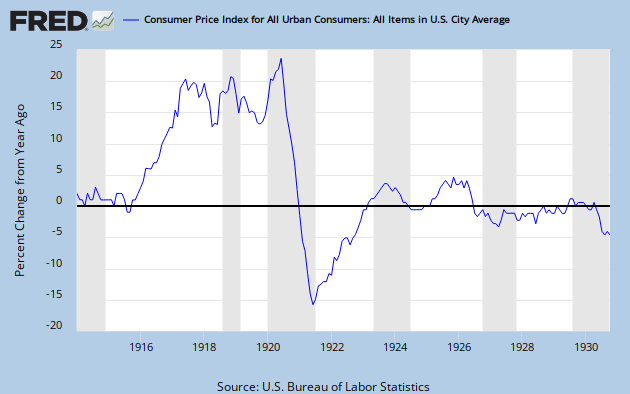
1. Inflation as price change: Let's start with the obvious, the 1920s was a decade of deflation; prices fell. Indeed the 1927–29 expansion was the only deflationary expansion of the entire 20th century. That's right, believe it or not the price level actually declined during the boom at the end of the 1920s.

This is correct, if by "price" we mean the consumer price index (CPI). A basket of typical household goods did indeed become cheaper from 1927 through 1929. In fact, this was one of my arguments in my own book about the Depression, to show why the modern hysteria over "deflation" is nonsense.

The typical economist or financial pundit today will warn that if prices ever began actually falling, then it would set in motion a vicious downward spiral as consumers postponed spending, waiting for further price falls. Well, this deflationary black hole obviously wasn't occurring in the heyday of the Roaring Twenties, showing that falling prices per se don't wreck an economy.

Ironically, Mises and Hayek themselves pointed to the relatively stable (i.e., noninflationary) consumer prices of the late 1920s to show why their theory (i.e., the Austrian explanation) was better than Irving Fisher's approach.Download PDF Fisher famously thought the US Fed had been doing a smashing job during the late 1920s, because after all it had kept the purchasing power of the dollar relatively stable.

From the Austrian perspective, this apparent stability was an illusion, and was masking the actual distortions building in the economy. (Had the Fed not inflated the money supply, increases in productivity would have yielded much sharper drops in consumer prices during the second half of the decade.)

Having disposed of the first case — where "inflation" refers to rising consumer prices — Sumner then turns to the a different definition for the term, namely a rising stock of money:

2. Inflation as money creation: At this point commenters start claiming that inflation doesn't mean rising prices, it means a rising money supply. I think that is absurd, as that would mean we lack a term for rising prices. But let's assume it's true. The next question is; which money? If inflation means more money, then don't you have to say "base inflation," or "M2 inflation?" After all, these quantities often go in dramatically different directions. Since the internet Austrians seem to blame the Fed, let's assume they are talking about the sort of money created by the Fed, the monetary base. In January 1920 the base was $6.909 billion, and in December 1929 it was $6.978 billion. Thus it was basically flat, and this was during a period where the US population and GDP rose dramatically.

Now this is extremely misleading. In fairness, Sumner is tackling the claim of whether there was an inflationary boom in "the 1920s," and so he understandably looked at the start and end dates for the decade. Yet look at the actual chart of the monetary base during the period:

Figure 1

By picking January 1920 as his start date, Sumner was in the midst of the huge inflationary boom during World War I (when the Fed was partially monetizing the massive debt issued by the federal government). To curb the rampant consumer price inflation (exceeding 20 percent on a year-over-year basis), the Fed jacked up rates and crashed the monetary base, ushering in the depression of 1920–1921.

Then, as the chart above clearly indicates, the Fed slammed on the gas again in early 1922. After this set in motion another unsustainable boom and inevitable bust, the Fed once again stepped on the gas in the early 1930s in a vain effort to inflate to prosperity. (See my book on the Depression, or Murray Rothbard's classic, to see the massive government distortions that made the post-1929 depression qualitatively worse than earlier ones, and prevented the smooth transition into another boom.)

To be sure, the above chart by itself doesn't clinch the Austrian story. My point is that Sumner's analysis would have you believe that the monetary base was flat throughout the 1920s, when in fact it moved at least qualitatively in the way we would expect from an Austrian perspective.

However, if Sumner's handling of the monetary base during the 1920s was a bit misleading, his treatment of other monetary aggregates might cause one's head to explode:

The broader monetary aggregates rose significantly [during the 1920s], but the government didn't even keep data on M1 and M2 until fairly recently. No one in the 1920s thought the Fed should be targeting aggregates that didn't even exist.

Let's make sure we understand the metaphysical magnificence of Sumner's argument here. In the comments he elaborated,

I've shown there was no inflation as the term was defined at the time. I've shown that there was no alternative non-inflationary policy as understood by policymakers at the time, including those in the 1920s who claimed the Fed was too inflationary. It makes no sense to argue things were inflationary because M2 went up, if M2 didn't exist. There are no policy implications. M2 was an idea invented much later.

Thus, to dispose of the "internet Austrian" claim that a rapid increase in the money stock — such as M2 — could have fueled an unsustainable boom, Sumner points out that nobody at the Fed during the 1920s even knew what "M2" was, so the things that currently comprise this measure (checking account balances, short-term deposits, etc.) couldn't possibly be at fault. I wonder how Sumner explains the massive deaths during the bubonic plague? Did doctors even know what bacteria were back then?

Unfortunately, online databases such as the St. Louis Fed don't have monetary aggregate data (such as M1, M2, etc.) going back far enough to be able to quickly generate charts. But we have this explanation from an interview with Joe Salerno, regarding the inflationary 1920s:

Including [the surrender cash value in permanent] life-insurance policies, the increase in Rothbard's money aggregate between mid-1921 and the end of 1928 totaled about 61%, yielding an annual rate of monetary inflation of 6.5%, compounded annually. Leave them out, and we get 55% over the period, or 6.0% per annum. For comparison, in the highly inflationary 1970s, the money stock grew at an average annual rate of 6.35%, including the double-digit Carter years.

Turning back to Sumner, let's look at his consideration of gold:

5. The price of gold: Lots of modern internet Austrians focus on soaring gold prices as an indicator of inflation. If we are going to use gold prices as a proxy, then here are the inflation rates for each year of the 1920s: 0%, 0%, 0%, 0%, 0%, 0%, 0%, 0%, 0%, and 0%.

This is cute, but of course hardly relevant since the United States was still on a gold standard at the time. Other asset prices did soar (as Sumner acknowledges). Regarding gold, however, we have this famous testimony in 1931 from A.C. Miller, whom Lionel Robbins called "the most experienced member of the Federal Reserve Board":

In the year 1927 … you will note the pronounced increase in [Federal Reserve] holdings [of US government securities] in the second half of the year. Coupled with the heavy purchases of acceptances it was the greatest and boldest operation ever undertaken by the Federal Reserve System, and, in my judgment, resulted in one of the most costly errors committed by it or any other banking system in the last 75 years!…

What was the object of Federal Reserve Policy in 1927? It was to bring down money rates, the call rate [the interest rate on loans to "margin buyers" who buy securities with borrowed capital — RPM] among them, because of the international importance the call rate had come to acquire. The purpose was to start an outflow of gold — to reverse the previous inflow of gold into this country.

The story is too long to recount here; the interested reader should consult my book. The short version is that following World War I, Great Britain tried to go back on the gold standard at the prewar parity, but this was an unrealistic goal given how much money they had printed during the war. The pound was hence overvalued, and gold was flowing out from the Bank of England and into the Federal Reserve. Thus, according to A.C. Miller and other evidence (such as statements by Benjamin Strong), the Fed deliberately eased its own stance in order to take pressure off of Great Britain.

Conclusion

Sumner will have to go back to the drawing board in his attempt to deny that there was any type of inflation during the 1920s. Using either the monetary base or broader aggregates, there was significant inflation after the 1920–1921 depression. Furthermore, we know that in 1927 the Fed deliberately adopted an "easy" policy with the aim of pushing down the very interest rate that governed stock speculation. The facts are entirely consistent with the Austrian explanation of the 1920s boom and crash.


Saludos
Rodrigo González Fernández
Diplomado en "Responsabilidad Social Empresarial" de la ONU
Diplomado en "Gestión del Conocimiento" de la ONU
Diplomado en Gerencia en Administracion Publica ONU
Diplomado en Coaching Ejecutivo ONU( 
  • PUEDES LEERNOS EN FACEBOOK


 CEL: 93934521
Santiago- Chile
Soliciten nuestros cursos de capacitación  y consultoría en GERENCIA ADMINISTRACION PUBLICA -LIDERAZGO -  GESTION DEL CONOCIMIENTO - RESPONSABILIDAD SOCIAL EMPRESARIAL – LOBBY – COACHING EMPRESARIAL-ENERGIAS RENOVABLES   ,  asesorías a nivel nacional e  internacional y están disponibles  para OTEC Y OTIC en Chile

Tuesday, December 06, 2011

The First Lady looks lovely in her orange argyle sweater as she harvests in the White House Kitchen Garden.

The First Lady looks lovely in her orange argyle sweater as she harvests in the White House Kitchen Garden.

Click to View Full Image

First Lady Michelle Obama and White House Chefs join children from Bancroft and Tubman Elementary Schools to harvest vegetables during the third annual White House kitchen garden fall harvest Oct. 5, 2011. Mrs. Obama planted the White House kitchen garden to help connect kids with the food they eat – an essential component of her Let's Move! initiative.


Fuente:

Saludos
Rodrigo González Fernández
Diplomado en "Responsabilidad Social Empresarial" de la ONU
Diplomado en "Gestión del Conocimiento" de la ONU
Diplomado en Gerencia en Administracion Publica ONU
Diplomado en Coaching Ejecutivo ONU( 
  • PUEDES LEERNOS EN FACEBOOK


 CEL: 93934521
Santiago- Chile
Soliciten nuestros cursos de capacitación  y consultoría en GERENCIA ADMINISTRACION PUBLICA -LIDERAZGO -  GESTION DEL CONOCIMIENTO - RESPONSABILIDAD SOCIAL EMPRESARIAL – LOBBY – COACHING EMPRESARIAL-ENERGIAS RENOVABLES   ,  asesorías a nivel nacional e  internacional y están disponibles  para OTEC Y OTIC en Chile

Presentan biografía de Felipe Cubillos a tres meses de la tragedia en Juan Fernández

ayer

Presentan biografía de Felipe Cubillos a tres meses de la tragedia en Juan Fernández

El texto, escrito por el periodista Eduardo Sepúlveda, recoge cartas, columnas y testimonios escritos por el empresario y fundador del Desafío Levantemos Chile.

Presentan biografía de Felipe Cubillos a tres meses de la tragedia en Juan Fernández
Foto: El Mercurio

SANTIAGO.- Esta tarde fue presentada la biografía del empresario Felipe Cubillos, quien falleció en el accidente aéreo ocurrido en Juan Fernández el 2 de septiembre pasado.

El texto, titulado "Felipe Cubilos, el desafío de un hombre que quiso ser un héroe", fue escrito por el periodista Eduardo Sepúlveda y es editado por El Mercurio-Aguilar.

Entre el material recopilado en el libro, de gran importancia para conocer el pensamiento y la acción del empresario y emprendedor social, se cuentan testimonios de cercanos, junto a cartas, discursos y columnas como las que publicó en el diario "La Segunda".

Asistieron al lanzamiento familiares y miembros de Desafío y los ministros de Defensa, Andrés Allamand; secretario general de Gobierno, Andrés Chadwick, y secretario general de la Presidencia, Cristián Larroulet, junto a directivos de la empresa El Mercurio y personalidades e invitados especiales.

"Es bonito que se pueda recoger en un libro la vida de Felipe y su testimonio, y que a tres meses de su muerte podamos recordarlo", expresó Marcela Cubillos, hermana del empresario.

El ministro de Defensa, en tanto, destacó la integridad y calidad humana de Felipe Cubillos. "Siempre dijo que no hay que rendirse, y destaca como un hombre agradecido y con devoción por Chile", rememoró.

Fuente:

Saludos
Rodrigo González Fernández
Diplomado en "Responsabilidad Social Empresarial" de la ONU
Diplomado en "Gestión del Conocimiento" de la ONU
Diplomado en Gerencia en Administracion Publica ONU
Diplomado en Coaching Ejecutivo ONU( 
  • PUEDES LEERNOS EN FACEBOOK


 CEL: 93934521
Santiago- Chile
Soliciten nuestros cursos de capacitación  y consultoría en GERENCIA ADMINISTRACION PUBLICA -LIDERAZGO -  GESTION DEL CONOCIMIENTO - RESPONSABILIDAD SOCIAL EMPRESARIAL – LOBBY – COACHING EMPRESARIAL-ENERGIAS RENOVABLES   ,  asesorías a nivel nacional e  internacional y están disponibles  para OTEC Y OTIC en Chile